
How to reduce interview no-shows in mass hiring
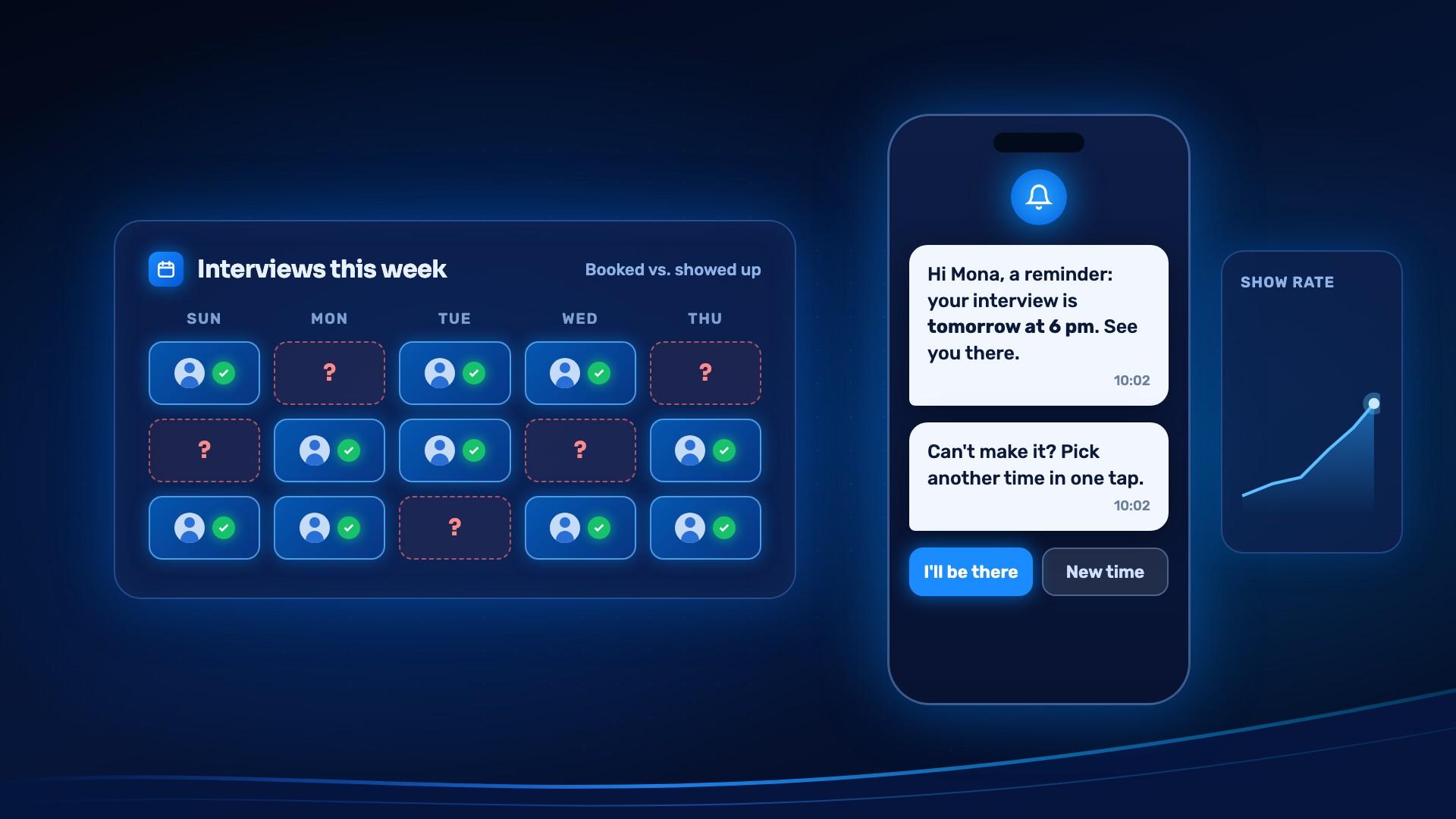
In mass hiring, a booked interview is not a hire, and often not even a conversation. Most no-shows are not about bad candidates. They come from time and friction: the gap between applying and hearing back, a slot that doesn't fit the candidate's day, a reminder they never saw, or no easy way to move the interview. Fix those four things and your show rate goes up without hiring a single extra recruiter.
This guide covers why candidates book and then disappear, seven fixes that work, and how to measure whether they're working.
Why candidates book and don't show up
Picture a customer service applicant in Cairo. They applied to ten jobs this week. Yours called back on day six and offered Tuesday at 11 am. By Tuesday:
- Someone else got there first. Another company called on day two and they already have a start date.
- The slot doesn't fit. They work a shift, study, or need an hour to commute, and 11 am on a weekday is the hardest time to get away.
- They forgot. The confirmation went to an email inbox they rarely open.
- Moving it felt harder than skipping it. There was no simple way to reschedule, so silence was easier than calling a recruiter.
- They weren't sure what to expect. Where to go, who they'd meet, what to bring, or which number would call them.
None of these say anything about whether the person would be good at the job. They're process problems, which means you can fix them.
1. Reply within a day, not a week
Speed is the biggest lever. The longer a candidate waits, the more likely they've moved on. Set a simple rule for your team: every new applicant hears back within one working day, even if the message is only "we've received your application, here's what happens next." In a big hiring wave this is hard to do by hand, which is why the first step is the one most worth automating.
2. Let candidates choose the time
When the recruiter picks the slot, the candidate has to fit around you. When the candidate picks, they choose a time they can actually make. Offer several slots, including early morning, evening or weekend options if your team can cover them. Shift workers and students are a big share of volume applicants, and office hours are exactly when they're busy.
3. Remind more than once, where they actually look
Reminders work, and more than one works better. There's little research on job interviews specifically, but healthcare has studied this well. A 2016 review of 21 randomised trials found that patients who got text reminders were 25% less likely to miss their appointment (no-shows fell from 21% to 15%), and that several reminders worked better than one (Robotham et al., BMJ Open, 2016). A hospital appointment is not a job interview, but the cause, people forgetting, is the same.
A simple sequence:
- A confirmation as soon as the interview is booked.
- A reminder the day before.
- A short reminder an hour or two before, with the address or the link.
Send them on the app candidates actually check. For most candidates in Egypt and the Gulf that's WhatsApp, not email.
4. Make rescheduling one tap
A candidate who can't make it will either tell you or vanish, and which one they pick depends on how easy you make it. Put a "need another time?" link or a simple "reply 2 to reschedule" in every reminder. A moved interview is a candidate you keep. A silent no-show is one you lose, along with the slot.
5. Tell them exactly what to expect
Uncertainty makes people hesitate. Every confirmation should answer the questions a nervous applicant has: where to go (with a map pin), who they'll meet, what to bring, and for phone screens, which number will call. If there's a language check, say so, so they can prepare instead of worrying.
6. Track show rate per source
You can't fix what you don't measure. Show rate is simple:
Show rate = interviews attended ÷ interviews booked
For example, if 200 candidates from one job board booked and 120 came, that source has a 60% show rate. Track it per sourcing channel, per recruiter and per time slot. You'll usually find that some channels bring plenty of bookings but few attendees, and some slots are always half empty. Move your budget and your calendar accordingly.
7. Cut the steps before the first conversation
Every step between "apply" and "talk to us" loses people: an account to create, a long form, a test to book, a call to wait for. Look at your process from the candidate's side and remove anything that doesn't help you decide. If you can, let the first screening happen at a time the candidate chooses, so nobody has to wait for a recruiter's calendar to open up.
For more on running large hiring waves, see our guide to high-volume hiring in Egypt.
Where Gahiz fits
We built Gahiz for that first step. Candidates take a structured voice interview from their phone, whenever suits them, in Arabic, English or the language of the role. Your recruiters get the transcript and a score for each answer, with the answer behind it, and book the people they want to meet. Your team makes every decision. Try the live demo or see how it works for hiring teams.