
How AI Mock Interviews Help You Practice and Land the Job
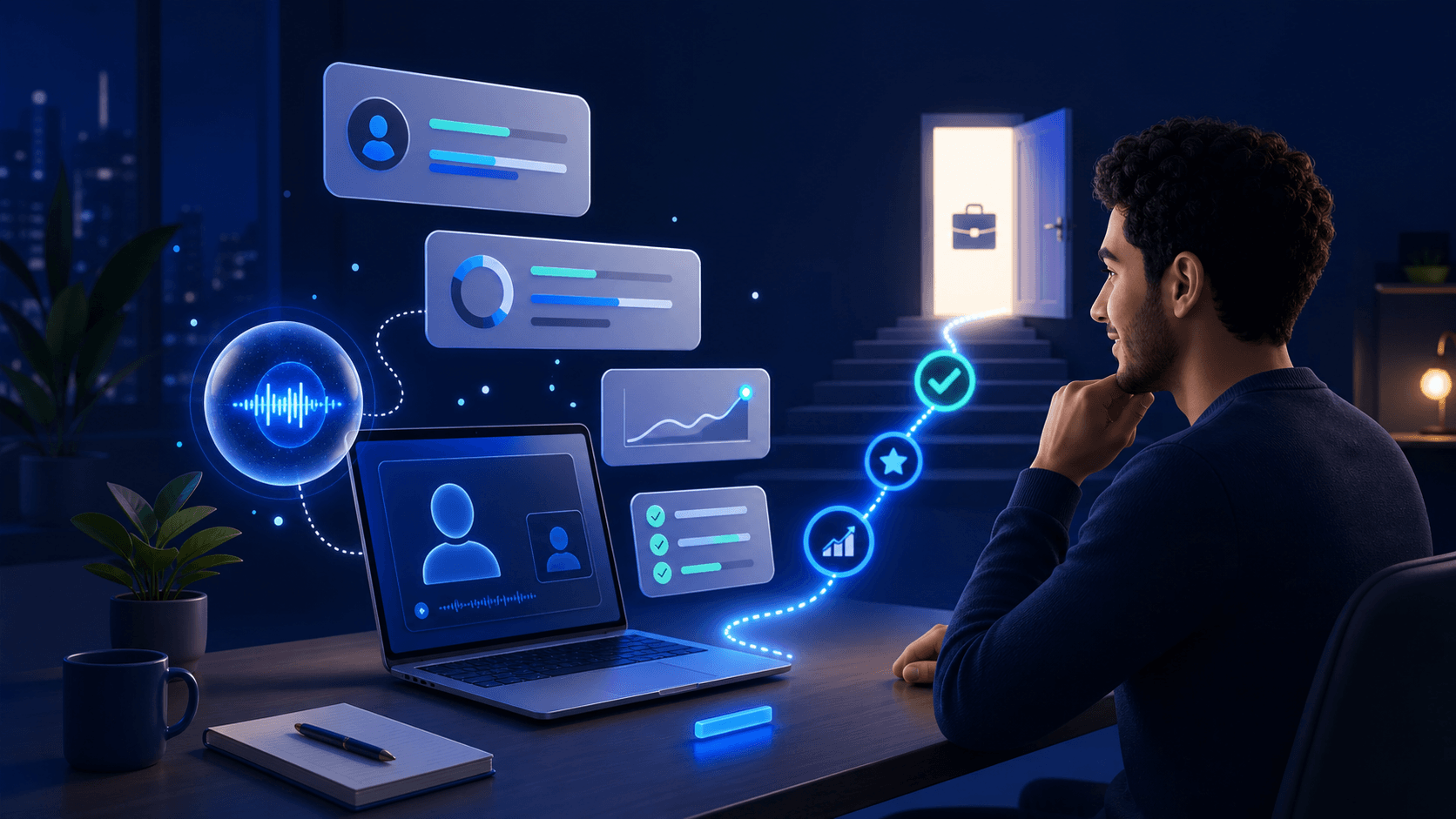
AI mock interviews let you rehearse for a real interview out loud, as many times as you want, and get instant feedback on how you actually came across. For most job seekers, that practice is the difference between freezing up and walking in confident.
You can read every "top interview questions" article on the internet and still freeze the moment a real interviewer asks you to speak. Knowing the answer in your head is not the same as saying it clearly, out loud, under pressure. That gap is exactly where most candidates lose offers, and it is exactly what AI mock interviews are built to close.
Why reading tips is not enough
Interview skill is a performance skill, like public speaking or playing an instrument. You cannot learn it by reading about it. You learn it by doing it, hearing yourself, and adjusting. The problem is that real practice has always been hard to get:
- A friend or family member runs out of patience after two or three questions.
- A career coach is expensive and only available at fixed times.
- Practicing in your head feels productive but never trains the part that actually fails on the day: speaking clearly in real time.
AI mock interviews remove every one of those limits. The interviewer is always available, never tired, and never judging you.
What an AI mock interview actually does
A good AI mock interview feels like the real thing, by voice:
- It asks you realistic questions for your specific role and level, not a generic list.
- It listens to your spoken answer, the way a real interviewer would.
- It follows up on what you said, so you have to think on your feet.
- It gives you instant, specific feedback: where you rambled, where you were vague, where you nailed it. Because it is AI, you can do it at midnight, repeat the same question ten times, and never feel embarrassed about a weak answer.
The five things it trains that reading cannot
| Skill | Why it only improves with spoken practice |
|---|---|
| Clarity | You hear your own filler words ("um", "like") and cut them |
| Structure | You learn to lead with the point instead of wandering to it |
| Confidence | Repetition turns a scary question into a familiar one |
| Thinking on your feet | Follow-up questions force real-time answers, not scripts |
| Pacing | You practice slowing down and breathing under pressure |
None of these improve from silently reviewing notes. All of them improve fast once you say your answers out loud and listen back.
A simple practice routine that works
You do not need hours a day. You need focused reps:
- Pick the questions you are almost guaranteed to get. Start with "tell me about yourself", "why this role", and your biggest strength and weakness.
- Answer them out loud in a mock interview, with no notes. This is the part that matters. Reading the answer does not count.
- Listen to the feedback and fix one thing at a time. Trying to fix everything at once goes nowhere.
- Repeat until the answer feels natural, not memorized. You want the shape of the answer in your head, not a script you recite.
Three focused sessions in the week before an interview will change how you show up.
It is not only for tech roles
Interviews are stressful whether you are applying to be an accountant, a sales rep, a nurse, a customer service agent, or a software engineer. The questions differ, but the skill is the same: explaining your experience clearly and confidently when someone is evaluating you.
AI mock interviews adapt to the role you are targeting, so a customer service candidate practices customer service scenarios and a software engineer practices technical ones. The practice is realistic either way.
Practicing in a second language
If your interview will be in English but Arabic is your first language, mock interviews are even more valuable. You get to make your mistakes in private, hear yourself, and build fluency before it counts.
Where Gahiz fits
This is exactly what Gahiz is built for. You can run realistic AI mock interviews by voice, in English or Arabic, for almost any role. You answer real questions out loud, the AI follows up like a real interviewer, and you get instant feedback on your clarity, structure, and delivery. It is private, available any time, and you can repeat it as many times as you need.
The takeaway
- Interview skill is a performance skill you build by doing, not reading.
- AI mock interviews give you unlimited, judgment-free, realistic practice.
- They train the things that actually fail on the day: clarity, structure, confidence, and thinking on your feet.
- A few out-loud sessions before an interview beat weeks of silent prep.
Stop rehearsing in your head. Say it out loud, get feedback, and walk in ready. Not sure how to open? Start with Gahiz.