
AI voice interview vs one-way video interview vs phone screen: which first interview fits volume hiring?
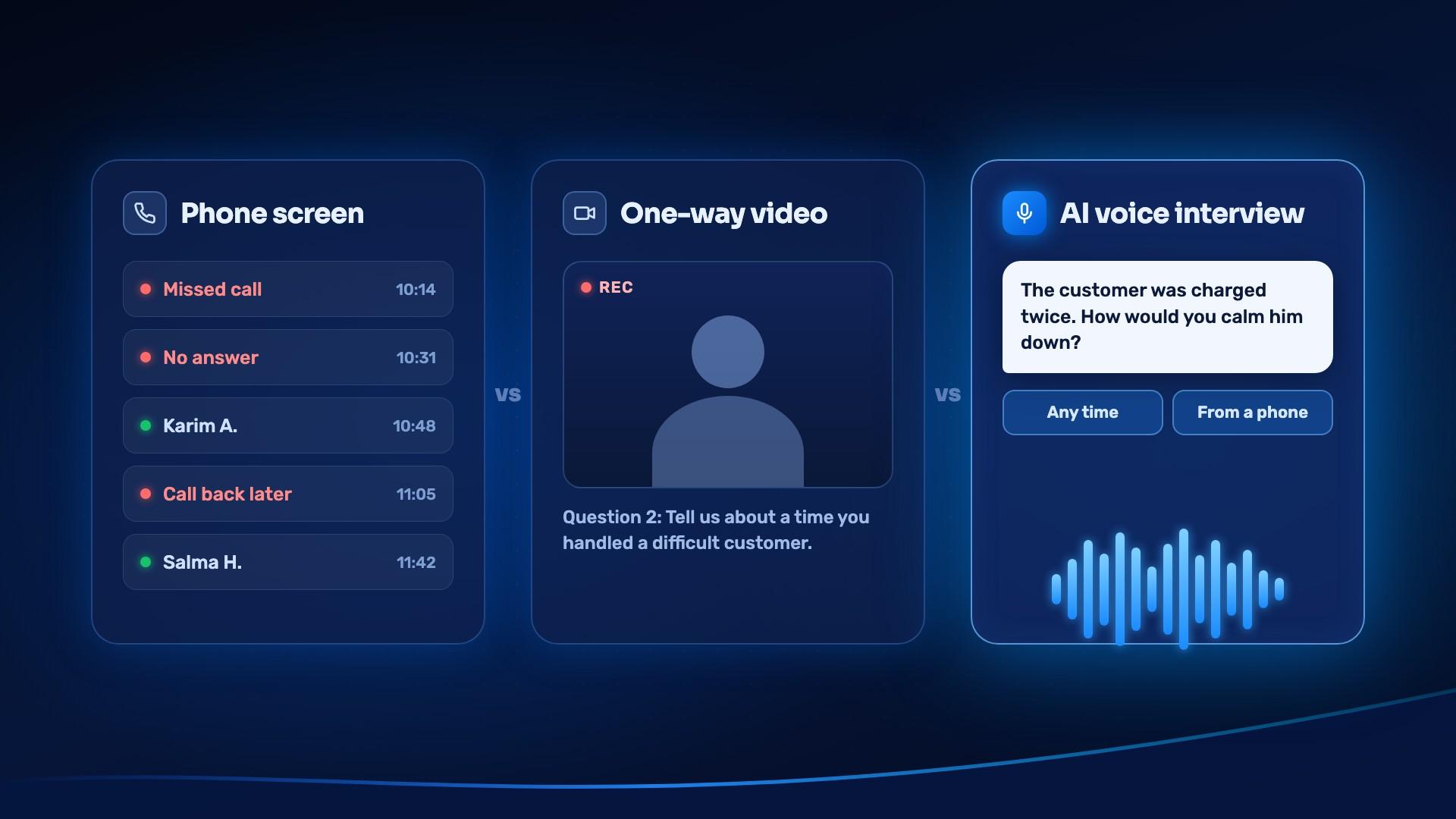
If you hire in volume, with hundreds of people applying for the same role, an AI voice interview is usually the best fit for the first round. Candidates answer by voice from their phone whenever it suits them, everyone gets the same questions, and your recruiters review answers instead of chasing calls. A phone screen is still the better choice when you only have a handful of applicants or need a real conversation to sell the job. A one-way video interview makes sense when how someone comes across on camera is part of the work, but it asks the most of the candidate.
Here is how the three compare on the five things that matter most in a first interview: candidate effort, recruiter time, consistency, the language check and candidate experience.
The three formats in plain words
- Phone screen. A recruiter calls the candidate, asks a few questions and takes notes.
- One-way video interview. The candidate sees questions on a screen, records video answers, and a recruiter watches the recordings later.
- AI voice interview. The candidate talks to an AI interviewer by voice. It asks set questions and follow-ups, and the recruiter gets a transcript and a score for each answer.
Candidate effort
A phone screen is easy to answer but hard to catch. The candidate has to be free when the recruiter calls, and anyone working a shift or sitting in class will miss it. Then comes the call back, and the call back to the call back.
A one-way video interview needs a working camera, a quiet room that looks presentable, enough mobile data to upload video and the confidence to talk to a lens with nobody nodding back. For a shift worker on a budget phone, that is a lot to ask before they have even spoken to you.
An AI voice interview needs a phone and a quiet corner. No camera, no booking, and the candidate picks the time.
Recruiter time
Phone screens grow one for one with applicants. Three hundred applicants means three hundred calls, plus the ones nobody picks up and the time spent arranging them. In a big hiring wave this is where recruiters lose their week.
One-way video removes the scheduling, but someone still has to watch every recording. That is faster than calling, but it is not free, and research on these interviews notes that reviewers can stop watching early, so a weak first answer can sink a candidate before they get going (Lukacik, Bourdage and Roulin, Human Resource Management Review, 2022).
With an AI voice interview, the recruiter's time goes to reading transcripts and scores and listening to the answers that matter. Nobody has to be on the line, so the team spends its hours on the shortlist instead of the dialling.
Consistency
This is the part most teams underrate. A large review of hiring research found that structured interviews, where every candidate gets the same questions and is scored against the same guide, predict job performance far better than unstructured ones: a validity of .42 against .19 (Sackett et al., Journal of Applied Psychology, 2022).
Phone screens can be structured with a script and a scorecard, but holding to it is hard. By call forty the recruiter is tired, some calls turn into friendly chats, and two recruiters rarely ask the same follow-up the same way.
One-way video keeps the questions identical, but the scoring still depends on who watches and when. One study found that people interviewed this way got higher ratings than people who answered the same structured questions by live video call (Langer, König and Krause, International Journal of Selection and Assessment, 2017). The authors' advice: don't mix formats within one hiring stage, or you end up comparing scores that don't mean the same thing.
An AI voice interview asks the same questions every time and scores every answer against the same guide. The best evidence so far is a field experiment covering about 70,000 applications for real entry-level jobs, with applicants randomly interviewed either by human recruiters or by AI voice agents, with humans making every hiring decision. Applicants interviewed by AI were 12% more likely to get a job offer, and the transcripts showed the AI interviews were more consistent (Jabarian and Henkel, 2026). It is a working paper, not yet peer reviewed, so treat it as a strong early signal rather than the final word.
The language check
For call centres, retail and hospitality, language is often the job itself. You need to hear the person speak.
A phone screen gives you the real thing, a live conversation. The catch is that the judgement depends on the recruiter's own level in that language, and that varies from person to person.
A one-way video lets you hear them too, but candidates usually get time to prepare, which can make rehearsed answers sound better than everyday speech.
An AI voice interview is a spoken conversation with follow-up questions, so you hear how someone speaks when they can't fully prepare. Because there is a recording and a transcript, a second person can check any answer later.
Candidate experience
Candidates notice the format. In the same 2017 study, people found the one-way video interview creepier and less personal than a live video call, and it raised more privacy worries. The authors warned that this could lead good people to drop out.
A phone screen feels the most human. The candidate can ask about the job, the shift and the pay. The cost is waiting days for a call that comes at the wrong moment.
An AI voice interview has no camera and no waiting, but it is still a conversation with a machine, and some people won't like that. Be upfront: tell candidates what the interview is, how it works and who reviews it, and give them a way to reach your team if something goes wrong.
Which one fits when
- Phone screen: a few applicants, senior or hard to fill roles, or when you need to sell the job in conversation.
- One-way video interview: roles where on-camera presence is part of the job, with candidates who are comfortable on camera.
- AI voice interview: hundreds of applicants for the same role, shift workers and students, roles where language matters, and any team that wants every candidate judged the same way.
Many teams mix them: an AI voice interview for the first round, then a phone call or an in-person meeting for the shortlist. For a step by step approach to that first round, see our applicant screening guide. If you are weighing tools, here is how we compare with other AI interview tools.
Where Gahiz fits
We built Gahiz for that first round. Candidates take a structured voice interview from their phone, whenever suits them, in Arabic, English or the language of the role. Your recruiters get the transcript and a score for each answer, with the answer behind it, and decide who moves on. See how it works for hiring teams.